The Man Who Made a Billion When a Billion Actually Meant Something
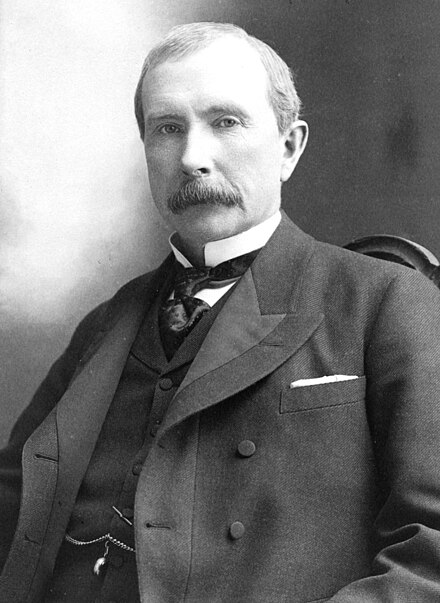
John D. Rockefeller became the richest human being in modern history. He was not just rich, but incomprehensibly wealthy. At his peak, his net worth was roughly $400 billion in today’s money. For context, that’s the same as Elon Musk has currently.
But here’s what nobody tells you about Rockefeller:
He wasn’t a workaholic grinding 18-hour days. He wasn’t frantically hustling, pulling all-nighters, or sacrificing his health for success. In fact, he insisted on eight hours of sleep every night and took daily walks in the middle of the workday.
So how did he build an empire that controlled 90% of America’s oil while working less frantically than the average modern entrepreneur?
The answer: discipline over intensity. Systems over hustle. Long-term thinking over short-term heroics.
After diving deep into Rockefeller’s habits and philosophy (brilliantly analyzed in Nic Munoz’s breakdown), I’ve extracted eight principles that separate empire-builders from burnout cases.
These aren’t motivational platitudes. These are battle-tested strategies from someone who played the game at the highest possible level and won.
Let’s break down exactly what made Rockefeller’s work ethic „insane“, and how you can apply it without becoming a 19th-century oil baron.
Principle 1: Work With Missionary Discipline (Not Manic Energy)
Rockefeller’s approach: Every single day began and ended the same way, with prayer and Bible reading. Not because he was performatively religious, but because these rituals anchored him to his mission.
He viewed his work as a sacred calling, not just a way to make money. This wasn’t about guilt or obligation, it was about connecting daily actions to a larger purpose given by god.
Why this matters for you:
Most entrepreneurs run on motivation like the newest David Goggins motivational compilation, which is basically emotional fuel. It burns hot, runs out fast, and leaves you empty when things get hard.
Rockefeller ran on discipline anchored to mission. He didn’t need to „feel like it“ because his daily rituals reminded him WHY he was doing this in the first place.
The modern application:
You don’t need to adopt Rockefeller’s specific religious practices, but you absolutely need equivalent rituals that connect you to your mission.
Create a daily routine that answers: Why does this work matter?
Examples:
- Morning ritual: 10 minutes reviewing your long-term vision and today’s role in achieving it
- Journaling: „What am I building toward? Why does today’s work matter?“
- Evening reflection: „Did today’s actions align with my mission?“
- Visual reminders: Keep your goal somewhere you see it every day (desktop background, phone lock screen, physical note)
The specific practice matters less than the consistency. Rockefeller did this every morning and evening for decades. That’s how you build unshakeable focus.
The difference between motivated people and disciplined people:
- Motivated: Work hard when inspired, procrastinate when not
- Disciplined: Work consistently because it’s connected to their identity and mission
Rockefeller was the latter. That’s why he won.
Principle 2: Conserve Energy and Control Emotions (Your Calmness Is Your Competitive Advantage)

Rockefeller’s approach: No matter what happened—criticism, attacks, crises, opportunities—he remained calm. People described him as almost unnaturally composed.
This wasn’t repression. It was strategic emotional management. He understood that emotional reactions drain energy that could be used for productive action.
While competitors were panicking during market crashes or raging at competitors, Rockefeller was calmly analyzing the situation and making rational decisions.
Why this matters for you:
Every emotional outburst is borrowed energy from your future self.
When you get angry at a client email, stressed about a competitor, or anxious about results, you’re not just feeling bad, but you’re literally depleting the cognitive resources you need for strategic thinking.
Rockefeller’s competitors made emotional decisions. He made calculated ones. That’s why he bought their companies when they failed.
The modern application:
This isn’t about becoming emotionless. It’s about creating space between stimulus and response.
The Rockefeller emotional management system:
- When something triggers you, pause: Before responding to that inflammatory email or stressful situation, take three deep breaths. Literally. This activates your nervous system and creates space for rational thought.
- Ask: „Will this matter in 5 years?“ Most things that feel urgent are irrelevant in the long term. Rockefeller thought in decades. That perspective naturally calms emotional reactions.
- Channel emotion into action: Feeling frustrated? Don’t vent—use that energy to solve the problem. Feeling anxious? Don’t spiral—create a plan.
- Build recovery practices: Rockefeller’s daily walks, prayer, and consistent sleep weren’t indulgences—they were how he reset his nervous system to maintain emotional control.
Tactical example:
Competitor launches a product that threatens your market share.
- Emotional response: Panic, obsess over their features, rush to copy them, make reactive decisions
- Rockefeller response: Acknowledge the competition, calmly analyze their actual impact, identify your unique advantages, make strategic decisions about whether/how to respond
The calm person wins because they’re making decisions based on reality, not fear.
Principle 3: Avoid Time-Wasting With Religious Conviction
Rockefeller’s approach: He had what the video calls a „holy consciousness“ about time. Wasting time wasn’t just inefficient, it was morally wrong. For Rockefeller, idleness was equivalent to sin.
This sounds extreme, but think about what it created: a man who treated every hour as sacred and irreplaceable.
Why this matters for you:
You probably don’t think you waste time. But track your actual behavior for one day:
- How much time scrolling social media „just for a few minutes“? For me, it has been 2 hours 🙁
- How many meetings that could’ve been emails?
- How much time in decision paralysis instead of action?
- How many hours consuming content versus creating value?
The average person wastes 3-4 hours per day. That’s 1,095-1,460 hours per year. That’s 45-60 full 24-hour days.
Imagine what you could build with an extra 60 days of productive time every year. You could read up to 126 books!
The modern application:
Develop Rockefeller’s „holy consciousness“ about time:
1. Time audit: Track everything you do for 3 days. Every 30 minutes, write down what you did. The results will horrify you. Good. Use that horror as motivation.
2. Eliminate before optimizing: Don’t try to be more productive at meaningless tasks. Cut them entirely.
Ask of every activity: „Does this move me toward my mission?“
- If yes: Keep it
- If no: Eliminate it
- If unsure: Probably eliminate it
3. Create „time protection“ systems:
- Block scheduling: Rockefeller knew exactly what he’d do each hour. Follow his lead. Plan your work day the day before!
- „No“ as default: He was ruthless about declining requests that didn’t serve his mission
- Batching: He handled similar tasks together (all correspondence at once, all meetings in sequence) to minimize context switching
4. Treat time as more valuable than money:
Rockefeller’s paradox: He obsessed over every penny AND valued his time above all else. Because time invested wisely generates money infinitely. Money wasted can be re-earned. Time wasted is gone forever.
Ask yourself: „If my time is worth $X per hour, what am I actually earning with this activity?“
If you’re scrolling TikTok for an hour and your time is worth $100/hour, you just paid $100 to watch random videos. Would you actually pay $100 for that? Then why are you doing it?
This mental model makes time waste viscerally painful. Which is exactly the point.
Principle 4: Think in Decades, Not Days (The Long-Term Advantage)

Rockefeller’s approach: From his very first job as a bookkeeper, he kept meticulous records. He tracked every penny. He reviewed every expense. This habit of precision and long-term thinking scaled with him, he applied the same discipline to billion-dollar deals.
He didn’t see business as a series of transactions. He saw it as a decades-long game of positioning and compounding.
Why this matters for you:
Short-term thinking is why most people fail. They make decisions based on immediate results instead of long-term positioning.
They choose:
- The quick sale over the long-term relationship
- The flashy strategy over the sustainable system
- The ego boost over the strategic advantage
- The fast money over the compounding asset
Rockefeller chose the opposite every time. That’s why he didn’t just get rich, but he built wealth that lasted generations.
The modern application:
The „10-year test“ for decisions:
Before making any significant business or career decision, ask: „Where will this put me in 10 years?“
Examples:
Decision: Take on a difficult, low-paying client who could become a major player
- Short-term: Pain, low immediate revenue
- 10-year: Major client, incredible testimonial, industry connections
- Rockefeller choice: Take the client
Decision: Cut quality to increase profit margins
- Short-term: Higher profits this quarter
- 10-year: Damaged reputation, commoditized product, no premium positioning
- Rockefeller choice: Maintain quality, reduce costs through efficiency instead
Decision: Spend time building systems versus doing client work
- Short-term: Less immediate revenue
- 10-year: Scalable business, freedom, leverage
- Rockefeller choice: Build the systems
The compounding effect of small decisions:
Rockefeller’s genius was understanding that small, consistent actions compound exponentially over time.
His meticulous bookkeeping as a teenager didn’t immediately make him rich. But it built the habit of precision that later saved millions in his oil empire.
His daily walks didn’t immediately generate breakthroughs. But over decades, they created space for the strategic thinking that crushed competitors.
Your application: What small habit, done consistently for 10 years, would transform your trajectory?
- Writing 500 words daily = 1.8 million words = multiple books, a blog empire, thought leadership
- Learning one new skill deeply per year = 10 world-class capabilities
- Building one relationship per week = 520 powerful connections
- Saving and investing 20% of income = financial freedom
The actions aren’t impressive daily but they’re transformative over decades.
Principle 5: Movement for Creativity (The Walking Billionaire)

Rockefeller’s approach: Like Tesla, Einstein, and Steve Jobs, Rockefeller took long daily walks. Not for exercise (though that was a bonus), but for strategic thinking and creative problem-solving.
He’d walk alone to develop ideas or walk with partners to plan strategy. These walks were where major decisions were made.
Why this matters for you:
Your best ideas will not come while you’re staring at a screen.
The brain’s „default mode network“—responsible for creativity, insight, and connection-making—activates during rest and light physical activity. It’s why you get ideas in the shower, on walks, or right before sleep.
Rockefeller intuitively understood what neuroscience has now confirmed: movement enhances cognition.
The modern application:
The walking strategy session:
- Daily creative walk: 30-60 minutes, no podcast, no music, just thinking. Bring a problem you’re working on. Let your mind wander. Capture insights on your phone.
- Walking meetings: Like Rockefeller, conduct strategy sessions while walking with partners or team members. The movement changes the dynamic, less formal, more creative, better ideas.
- The „no solution at desk“ rule: If you’ve been stuck on a problem for 30 minutes at your desk, don’t force it. Walk. The answer will often come when you stop trying so hard.
Why this works:
- Physical movement increases blood flow to the brain
- Changing environment provides new stimuli for pattern recognition
- Walking rhythm has a meditative quality that reduces mental noise
- Getting away from screens reduces the addiction loop and allows deeper thinking
Rockefeller’s routine: Morning prayer/reading → work → midday walk → work → evening walk → prayer/reading → sleep
Notice: He built thinking breaks INTO his day, not as rewards after productivity but as PART OF productive work.
Steal this structure.
Principle 6: Prioritize Sleep and Recovery

Rockefeller’s approach: He insisted on eight hours of sleep every night. Non-negotiable. Even at the height of building his empire, he prioritized rest.
For him, sleep was a strategic asset, not time wasted.
Why this matters for you:
The „hustle culture“ glorifies sleep deprivation. „I’ll sleep when I’m dead.“ „Sleep is for the weak.“ „Success requires sacrifice.“
This is stupidity disguised as ambition.
Rockefeller understood what science now proves: Sleep deprivation destroys:
- Cognitive performance (decision-making, creativity, problem-solving)
- Emotional regulation (you become reactive and impulsive)
- Physical health (immune system, metabolism, longevity)
- Learning and memory consolidation
Every hour of sleep you sacrifice for „productivity“ costs you multiple hours of impaired performance the next day.
Rockefeller slept 8 hours and built a $400 billion empire. You sleep 5 hours and struggle to build a $4K business. See the problem?
The modern application:
The Rockefeller sleep protocol:
- Non-negotiable 8-hour sleep window: If you need to wake at 6am, you’re in bed by 10pm. Not „starting bedtime routine“ at 10pm—asleep by 10pm.
- Consistent schedule: Rockefeller went to bed and woke at the same time every day. Your circadian rhythm thrives on consistency.
- Evening wind-down ritual: Like his evening prayer and reading, create a routine that signals to your body it’s time to rest:
- No screens 60 minutes before bed. Rockefeller did not had that problem 😉
- Dim lights (or use blue light blockers)
- Reading, journaling, or light stretching
- Consistent environment (cool, dark, quiet room)
- Recovery mindset: Rockefeller didn’t see rest as weakness, he saw it as competitive advantage. While exhausted competitors made poor decisions, he made clear-headed strategic moves.
The performance equation:
Mediocre strategy + great execution + well-rested brain = Success
Great strategy + poor execution + exhausted brain = Failure
Rockefeller’s edge: He combined great strategy with great execution, powered by a well-rested mind.
Stop bragging about how little you sleep. Start bragging about the quality of your work and decisions.
Principle 7: Lead With Humility and Delegation (The Anti-Tyrant Billionaire)

Rockefeller’s approach: Contrary to the stereotype of ruthless 19th-century tycoons, Rockefeller wasn’t a dictatorial micromanager. He promoted teamwork, consensus-building, and employee autonomy.
He hired smart people and gave them responsibility. He built systems that ran without his constant intervention.
Why this matters for you:
The entrepreneur’s trap: You start a business because you’re good at something. You grow it by doing everything yourself. You hit a ceiling because you can’t scale beyond your personal capacity.
Rockefeller avoided this trap by building leadership leverage.
He understood: Your business can only grow as much as your ability to delegate and build systems.
The modern application:
The delegation framework:
- Identify your unique value: What can ONLY you do? Strategy, vision, key relationships, specific creative work? Do that. Delegate everything else.
- Hire for autonomy: Rockefeller didn’t hire order-takers. He hired people who could think independently and make decisions. Look for people who can own outcomes, not just complete tasks.
- Build systems, not dependencies: Document processes. Create SOPs. Make it possible for work to happen without you being involved in every decision.
- Trust and verify: Give people autonomy, but create accountability structures. Rockefeller reviewed numbers meticulously but didn’t micromanage daily operations.
Rockefeller’s leadership principle:
„I would rather earn 1% off 100 people’s efforts than 100% off my own efforts.“
This is the difference between a freelancer and a business owner. Between working IN your business and working ON your business.
The humility advantage:
Rockefeller’s ego wasn’t tied to being the smartest person in the room. It was tied to building the best organization. That freed him to hire people smarter than him in specific domains.
Ask yourself:
- Where am I holding onto control that’s limiting growth?
- What tasks am I doing that someone else could do 80% as well?
- How can I create systems that don’t require my constant involvement?
The goal isn’t to make yourself dispensable—it’s to make yourself strategically focused rather than operationally overwhelmed.
Principle 8: Precision and Efficiency (Cut Fat, Not Potential)

Rockefeller’s approach: He fought waste with „religious fervor.“ Every barrel, every piece of metal, every minute should be optimally used. He famously analyzed his operations to save pennies per barrel, which, at scale, meant millions in savings.
But here’s the key: He cut waste, not investment in the future.
Why this matters for you:
Most people confuse frugality with being cheap. They cut costs in ways that destroy value:
- Hiring the cheapest talent (and getting poor results)
- Skipping on tools that would save time
- Avoiding investments in learning or systems
- Nickel-and-diming clients or partners
Rockefeller’s approach was different: Ruthlessly eliminate waste and inefficiency, but invest heavily in anything that compounds.
The modern application:
The precision audit:
Look at your business or work and identify:
Waste to eliminate:
- Subscriptions you don’t use
- Meetings that could be async updates
- Processes that have unnecessary steps
- Tools that overlap or underperform
- Time spent on low-value activities
Investments to maintain or increase:
- Top talent (Rockefeller paid well for exceptional people)
- Tools that multiply your effectiveness
- Learning and skill development
- Systems and automation
- Quality that differentiates you
Rockefeller’s efficiency formula:
- Measure everything: You can’t optimize what you don’t measure. He tracked every expense. You should track time, money, and results.
- Identify bottlenecks: Where is value being lost? Where are resources being wasted?
- Systematize solutions: Don’t just fix it once. Create a system so it stays fixed.
- Iterate constantly: Rockefeller didn’t optimize once and stop. He continuously looked for 1% improvements that compounded to massive advantages.
Modern example:
Waste: Spending 10 hours/week on manual data entry Investment: $200/month automation tool that eliminates the task Result: 520 hours saved annually (13 full work weeks) + improved accuracy
The Rockefeller question: „How can I get better results with less waste?“
Not „How can I do this cheaper?“ but „How can I do this MORE EFFICIENTLY while maintaining or improving quality?“
The Rockefeller System: How It All Fits Together
These aren’t isolated tactics. They’re an integrated system:
1. Mission-driven discipline gives you direction
2. Emotional control preserves energy for what matters
3. Time consciousness ensures you’re investing in the right activities
4. Long-term thinking guides strategic decisions
5. Movement and rest maintain cognitive performance
6. Delegation and systems create leverage
7. Precision and efficiency maximize returns on effort
The compounding effect:
Rockefeller didn’t just work hard. He worked sustainably, strategically, and systematically.
That’s why he built an empire that lasted generations rather than burning out in five years like most entrepreneurs.
Your Rockefeller Challenge: Build the System in 30 Days
Reading about principles changes nothing. Implementation changes everything.
Here’s your 30-day challenge to build your own Rockefeller system:
Week 1: Foundation
- Day 1-2: Define your mission. Write it down. Create a daily ritual to connect to it by praying, visualizing or meditating on it.
- Day 3-4: Time audit. Track every hour for 2 days. Identify waste.
- Day 5-7: Create your sleep schedule. Commit to 8 hours for the next 23 days.
Week 2: Execution
- Day 8-10: Implement one emotional control practice (3 deep breaths before responding to triggers)
- Day 11-14: Start daily walks (30 min minimum, no distractions)
Week 3: Leverage
- Day 15-17: Identify 3 tasks you can delegate or eliminate
- Day 18-21: Document one process/system in your work
Week 4: Optimization
- Day 22-25: Run precision audit (identify 3 wastes to eliminate)
- Day 26-28: Make one decision using the „10-year test“
- Day 29-30: Review and refine your system
Track your progress. At the end of 30 days, ask:
- How has my decision quality changed?
- How has my energy changed?
- What results am I seeing?
The Bottom Line: Work Like Rockefeller, Not Like a Burnout Case
The irony of Rockefeller’s „insane work ethic“ is that it wasn’t insane at all, it was profoundly sane.
He didn’t grind himself into the ground. He didn’t sacrifice health for wealth. He didn’t hustle frantically.
He built systems, maintained discipline, thought strategically, and played the long game.
And he became the richest person in modern history while sleeping eight hours a night and taking daily walks.
The lesson isn’t „work harder.“ It’s „work smarter, longer, and more sustainably than everyone else.“
Fast success is usually followed by fast failure. Rockefeller built something that lasted because he thought in decades, not quarters.
The question isn’t: „Can you hustle hard for a year?“
The question is: „Can you maintain disciplined, strategic, efficient work for 10 years?“
That’s the Rockefeller advantage. That’s what builds empires.
Now stop reading and go implement one principle today.
Your future empire is waiting.